From your ERP to a signed eCoC: how CoCDesk integrates with stage 1 and stage 2 vehicle manufacturers
The eCoC data already exists. The hard part is the hand-off.
By the time a vehicle rolls off your line, every field an eCoC needs has already been generated and approved somewhere in your stack:
- Type-approval references and variant/version codes sit in your homologation master data — whether the approval was issued by the VCA for the UK market or by an EU type-approval authority for vehicles destined for the EU.
- VIN, build options, masses, axle loads, dimensions come out of the production order or the configurator.
- Engine, transmission, emissions class, fuel type are linked to the variant.
- Conformity of Production (CoP) records are written by your quality system.
The problem isn't that the data doesn't exist. It's that today it lives in the ERP, the MES and the homologation database — and gets pulled out by hand to fill an IVI XML template, validated by hand, signed by hand, and uploaded by hand to the destination national access point. That works for a handful of vehicles. It doesn't work for hundreds or thousands a year.
How CoCDesk plugs in
CoCDesk is built to consume the data you already have. There are three integration patterns we use depending on how mature your IT stack is:
1. Direct API integration
For modern ERPs and MES platforms, the production system pushes the vehicle record to CoCDesk over a REST or message-bus API as soon as the build is signed off by quality. A per-customer mapper converts the payload to the IVI 2.0 schema.
2. File drop (CSV / XML / EDI)
Where the ERP is too restricted or change windows are slow, CoCDesk picks up a scheduled export from a watched folder, SFTP path or S3 bucket. Same mapper, same output. Many customers start here and graduate to API integration once the value is proven.
3. Configurator-driven mode
If you have a vehicle configurator that already encodes how options affect masses, dimensions and emissions, CoCDesk can read its output directly. This is the cleanest model for stage 2 builds where every body variant changes payload and approval references.
Typical inbound payload: production order ID, VIN, base type-approval, variant + version, build options, measured masses, completed-vehicle CoP flags.
ERP and MES systems CoCDesk works with
We have shipped or scoped integrations against the systems UK body builders and stage 1 / stage 2 manufacturers actually run:
| Layer | Systems we work with |
|---|---|
| Tier-1 / OEM ERP | SAP S/4HANA, Oracle Fusion Cloud ERP |
| Mid-market automotive ERP | Infor CloudSuite Automotive, Plex (Rockwell), DELMIAworks (Dassault Systèmes), Microsoft Dynamics 365 F&O, IFS Cloud, Epicor Kinetic |
| UK / European body-builder ERP | Sage X3, Sage 200, SAP Business One, abas ERP, proAlpha |
| Production execution / MES | Siemens Opcenter, Rockwell Plex MES, Dassault Apriso, AVEVA System Platform, Tulip |
| PLM / type-approval data | Siemens Teamcenter, Dassault ENOVIA, Aras Innovator, in-house homologation databases |
If a system isn't on the list, the integration model is the same — we build a mapper against your data contract. The complex bit is your business rules, not the connector.
The end-to-end data flow
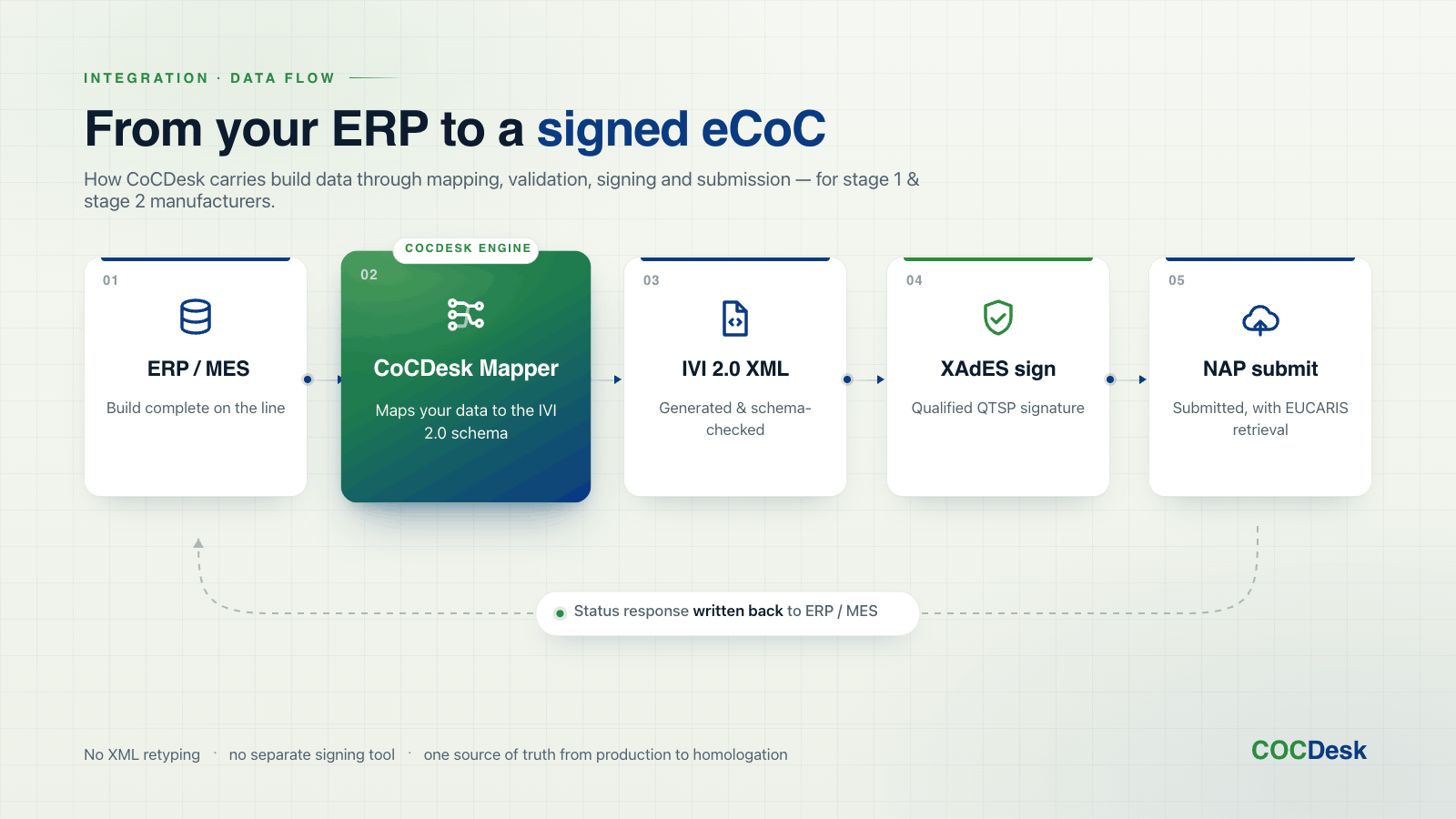
The diagram above maps the full path. From the production system, CoCDesk runs the per-customer mapper, produces a schema-checked IVI 2.0 XML, applies a XAdES signature from a Qualified Trust Service Provider on the EU Trusted List, and submits to the destination national access point (NAP) — using EUCARIS retrieval where the destination Member State accepts a submission via a foreign NAP.
For UK manufacturers selling into the EU after Brexit, the practical route is submission through an EU NAP — most commonly the RDW in the Netherlands — with the destination Member State retrieving the eCoC via EUCARIS. CoCDesk handles the routing logic so your team doesn't have to track which Member State accepts what.
The receipt and any rejection reasons are written back to the originating record in your ERP or MES — so the production system shows the eCoC status next to the vehicle, not in a separate spreadsheet.
Stage 1 vs stage 2: the multi-stage hand-off
The integration shape changes depending on whether you build the base vehicle or complete it.
Stage 1 — base-vehicle manufacturer
Typically chassis and chassis-cabs. The CoCDesk integration sits next to the production-order completion event. The eCoC you submit covers the incomplete vehicle and carries the base type-approval reference that the next stage will need.
Stage 2 — body builder / converter
Your eCoC has to reference the upstream eCoC issued by stage 1. CoCDesk handles this by either receiving the base eCoC XML via EUCARIS retrieval (preferred) or by accepting the base type-approval reference from the chassis manufacturer's data sheet. Your stage 2 eCoC adds completed-vehicle masses, body type and axle configuration, then re-signs.
The pain point we eliminate at the hand-off
Mass and dimension drift between what stage 1 declared and what stage 2 measures. CoCDesk flags the divergence and asks for sign-off before the eCoC is submitted — so you don't get a NAP rejection because completed mass exceeds technically permissible mass.
What an integration project looks like
For a typical body builder running on Sage X3 or proAlpha:
- Week 1 — data-mapping workshop. We sit with your homologation lead and ERP admin and walk the IVI 2.0 schema against your fields. Output: a one-page data contract.
- Weeks 2–4 — connector built and pointed at your test environment. We generate test eCoCs from sample vehicles and submit to the NAP test endpoint.
- Weeks 5–6 — parallel run. CoCDesk generates eCoCs alongside your existing process; output is compared field-by-field.
- Week 7+ — production cutover. Manual eCoC generation retires.
For stage 1 manufacturers on SAP S/4HANA the discovery and security review takes longer, but the technical build is faster because the source data is cleaner.
When the integration pays for itself
In practice, the realistic ceiling for manual eCoC generation is fewer than 50 eCoCs per year. IVI 2.0 XML isn't a format designed for a human eye — it's dense, deeply nested, and full of code-list values that look interchangeable but aren't. Hand-keying it at any meaningful volume is bound to produce mistakes, and every mistake is a NAP rejection plus a re-sign cycle. Above that threshold, ERP/MES integration is no longer a cost optimisation — it's the only workflow that holds up.
The other thing teams underestimate: the integration isn't only about generating eCoCs faster. Because the same source of truth feeds both production and homologation, you also remove an entire class of mismatches between your build records and the documents you submit to the authority — which is exactly where Conformity of Production audits get tense.
CoCDesk for UK stage 1 and stage 2 manufacturers
- IVI 2.0 XML generation from your ERP, MES or configurator
- Mappers maintained per customer; updates roll out as schemas change
- Schema validation before submission, signed XAdES output from a QTSP certificate
- Direct submission to every EU NAP, plus EUCARIS retrieval for cross-border base/completed vehicle pairing
- Status write-back to the originating ERP or MES record
- Full audit trail for Conformity of Production
If you build vehicles in stages for the EU market, the bottleneck for the 29 November 2026 deadline isn't the regulation — it's the hand-off between your production system and the destination registration authority. We can build that hand-off in weeks.
Next article
eCoC in the EU: situation update
Ready to meet the UK eCoC deadline?
Book a free demo and see how COCDESK can have your eCoC process production-ready before the VCA mandate takes effect.